

Educators Are Not Therapists
I recently finished reading Bad Therapy: Why the Kids Aren't Growing Up, a 2024 nonfiction book by Abigail Shrier, known for her vocal opposition to social-emotional learning in schools, skepticism toward mental health professionals, and strong advocacy for the movement and legislative push guaranteeing parents’ authority over their children’s education, health, and upbringing, known as “parents' rights.” The book has generated significant debate. Supportive reviewers have praised it for questioning assumptions about therapy culture and for highlighting potential harms of overdiagnosis and excessive therapeutic intervention. Critics, including some therapists and mental-health professionals, argue that Shrier overstates her case, selectively interprets evidence, or frames complex issues too broadly.
I picked up the book because I believe meaningful growth requires engaging with perspectives beyond our own. It is easy to surround ourselves with voices that reinforce what we already think. It is much harder, and often more valuable, to listen carefully to viewpoints that challenge our assumptions.
What surprised me most was not where we disagreed, but where we agreed.
As I worked through the book, I found myself nodding my head far more often than I anticipated. While I do not share all of the author's conclusions, many of the concerns she raises reflect tensions I have observed in schools, mental health services, and helping professions more broadly.
Below is a brief overview of several key arguments from the book and how they connect to the Rooted in Hope framework. In many cases, the concern being identified is legitimate. Where Rooted in Hope differs is not in recognizing the problem, but in how we respond to it, seeking to balance support with accountability, compassion with responsibility, and safety with growth.
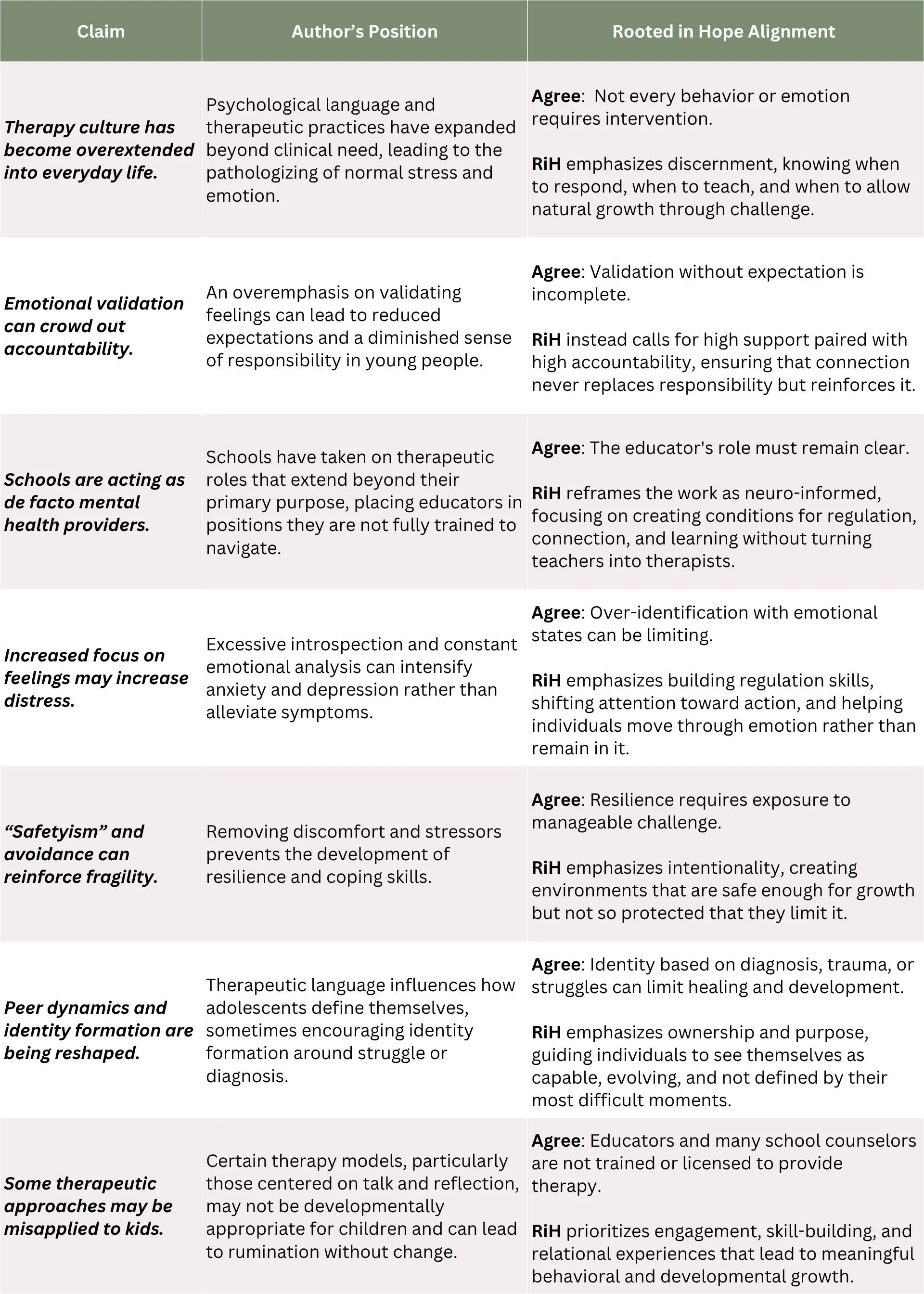
Books like this are valuable not because they provide all the answers, but because they force us to examine our assumptions.
As educators, mental health professionals, parents, and leaders, we should be willing to ask difficult questions of our own practices.
Are we building resilience or dependency?
Are we teaching coping skills or simply increasing awareness of distress?
Are we creating environments that support growth, or unintentionally removing the very challenges through which growth occurs?
These are not either-or questions. They require nuance, reflection, and a willingness to hold competing truths simultaneously.
Young people need support. They also need responsibility. They need validation. They also need a challenge. They need adults who understand the impact of stress and trauma while maintaining confidence in their capacity to learn, adapt, and overcome.
The goal is not to raise children who never struggle. The goal is to raise children who know how to struggle well—supported by caring adults, grounded in meaningful relationships, and equipped with the skills to navigate adversity.
As you reflect on the ideas presented here, I invite you to consider not only where you agree or disagree with the author, but what these questions reveal about your own beliefs. Growth rarely happens inside an echo chamber. It happens when we are willing to listen, reflect, and remain open to the possibility that our understanding can deepen.
Stay rooted.
